
Third-party liability insurance
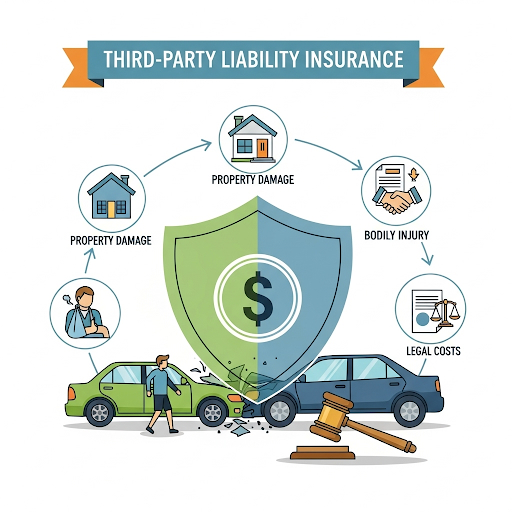
Third-Party Liability Insurance is a form of motor insurance that is compulsory under the Motor Vehicles Act, 1988 for all vehicle owners in India. Third-party liability insurance is a legal and financial safeguard for third parties affected by accidents involving insured vehicles, but it does not protect the insured’s own vehicle or person.
Eligibility
Eligibility Criteria for Third-Party Liability Insurance
- Any individual or entity owning a registered motor vehicle in India is eligible.
- It is legally mandatory for all registered vehicle owners.
- No special restrictions beyond owning a registered vehicle and complying with registration requirements.
- The insurance must be obtained before operating the vehicle on public roads.
Vehicle-Specific Nature of Third-Party Insurance
- The insurance policy is tied to a specific vehicle (identified by its registration number).
- Coverage applies only to the insured vehicle, not to other vehicles owned by the same person.
- If the vehicle is sold, the insurance can be transferred to the new owner (who must update the policy details).
- Each vehicle must have its own separate third-party liability insurance policy.
Features of Third-Party Liability Insurance
It is compulsory under the Motor Vehicles Act, 1988 for all vehicles operating on Indian roads.
Provides financial protection against legal liabilities arising from injury, death, or property damage caused to a third party due to an accident involving the insured vehicle.
Compensation for third-party property damage is typically capped at ₹7.5 lakh.
It does not cover any damage to the insured’s own vehicle or personal injuries to the policyholder.
Premium rates are fixed by the Insurance Regulatory and Development Authority of India (IRDAI) and are uniform across insurers.
For new cars, a three-year policy is required at registration; for older vehicles, it is renewed annually.
Claims are settled through the Motor Accident Claims Tribunal (MACT), which decides the compensation amount for third-party injury or death.
Policies can be purchased or renewed both online and offline.
Shields the policyholder from financial and legal consequences of third-party claims.
Requires prompt notification to the insurer, FIR filing, and submission of necessary documents for claim processing.
Terms and Conditions of Third-Party Liability Insurance
Mandatory by Law: Every vehicle owner must have third-party liability insurance under the Motor Vehicles Act, 1988. Driving without it is illegal and punishable by fines or imprisonment.
Coverage Provided:
- Bodily Injury/Death: Covers legal liability for injury, disability, or death of a third party caused by the insured vehicle.
- Property Damage: Covers damage to third-party property, typically up to ₹7.5 lakh.
- Legal Expenses: Covers basic legal costs arising from third-party claims.
- Medical Expenses: Includes costs for hospitalization and treatment of the injured third party.
Exclusions:
- Does not cover damages to the insured’s own vehicle or personal injuries to the policyholder.
- No compensation for belongings inside the vehicle at the time of the accident.
- No coverage for natural calamities or own vehicle damage.
Claims Process:
- The policyholder must inform the insurer immediately after an accident.
- An FIR must be filed if there is significant damage, injury, or death.
- All necessary documents (policy, driving license, registration, FIR) must be submitted.
- Claims are settled through the Motor Accident Claim Tribunal (MACT).
Fault-Based: Claims are generally fault-based, meaning the third party must prove the insured was at fault for the accident.
Transferability: The insurance certificate can be transferred to a new owner if the vehicle is sold, with the new owner required to update details within 14 days.
Premium Regulation: Premium rates are fixed and regulated by the Insurance Regulatory and Development Authority of India (IRDAI).
Limitations: The policy only benefits the third party; the insured is not compensated for their own losses or injuries.
Legal Proceedings: Legal aid is often required, and the insurer pays compensation directly to the third party, not to the insured.
Pros and Cons of Third-Party Liability Insurance
Pros:
Legally mandatory and ensures compliance.
Provides financial protection against third-party injury, death, or property damage.
Affordable premiums and easy to purchase/renew.
Includes legal support and a straightforward claims process.
Offers peace of mind for vehicle owners.
Cons:
Does not cover damage to your own vehicle or personal injuries.
No protection against theft, fire, or natural calamities.
Limited compensation for third-party property damage.
Not suitable for new or high-value vehicles needing comprehensive coverage.
Claim settlements may involve legal procedures.
Scenarios Where Claims Might Get Rejected:
Delay in Reporting the Accident:
Failing to inform the insurer within the stipulated time (often 24–48 hours) can lead to rejection.
Invalid or Expired Driving License:
If the driver did not possess a valid license at the time of the accident, the claim will be denied.
Non-Payment or Lapsed Policy:
Claims filed under expired or unpaid policies are rejected.
Fraudulent or False Claims:
Any attempt to exaggerate, falsify, or misrepresent the accident or damages can result in outright denial and possible legal action.
Undeclared Modifications:
Not informing the insurer about major modifications to the vehicle (like engine changes) can void the claim.
Violation of Motor Vehicle Laws:
Claims are rejected if the accident occurred while breaking laws (drunk driving, racing, using the vehicle for commercial use when insured for private use, etc.).
Incomplete or Incorrect Information:
Missing or inaccurate details in the claim form or supporting documents can result in rejection.
No Third-Party Involvement:
For third-party liability claims, if there is no actual third-party damage or injury, the claim will not be accepted.
Policy Exclusions:
If the incident falls under specific exclusions mentioned in the policy (such as war, nuclear risks, or unauthorized use), claims will be denied.
How to avoid such scenarios
Report the Accident Immediately: Notify your insurer as soon as the accident occurs, providing accurate details about the incident.
Lodge an FIR Without Delay: File a First Information Report at the nearest police station and keep a copy for your records, as it is often mandatory for claim processing.
Use a Valid Driving License: Ensure that the driver at the time of the accident holds a valid and current driving license.
Read More
Avoid Unauthorized Repairs: Do not repair your vehicle before the insurer inspects the damage. Wait for their assessment and provide photographic evidence if possible.
Keep Your Policy Active: Renew your insurance policy before it expires to maintain continuous coverage.
Provide Complete and Accurate Documentation: Submit all required documents (insurance policy, FIR, RC, driving license, claim form, and accident photos) and ensure they are accurate and complete.
Be Honest and Transparent: Provide truthful information about the accident. Misrepresentation or omission of facts can lead to rejection.
Know Your Policy Terms: Read and understand your policy’s terms, conditions, and exclusions to avoid mistakes.
File the Claim Within the Stipulated Timeframe: Adhere to the insurer’s deadline for claim submission to avoid rejection.
Follow Legal Procedures: Cooperate with the Motor Accident Claims Tribunal (MACT) and comply with all legal requirements for third-party claims.
Avoid Policy Violations: Do not use the vehicle for unauthorized purposes (e.g., using a private car commercially), and inform your insurer of any modifications (like installing a CNG/LPG kit).
Do Not Drive Under Influence: Never drive under the influence of alcohol or drugs, as this will result in claim denial.
