
What is Car Insurance?
Car insurance is vehicle specific motor insurance, tailored for private cars, covering own damage, third party liability, theft, disaster and collision coverage. Additional coverage like personal injury protection, zero depreciation, engine protection, and add-ons can enhance the scope of coverage. These are typically components of a comprehensive car insurance policy tailored for private cars.
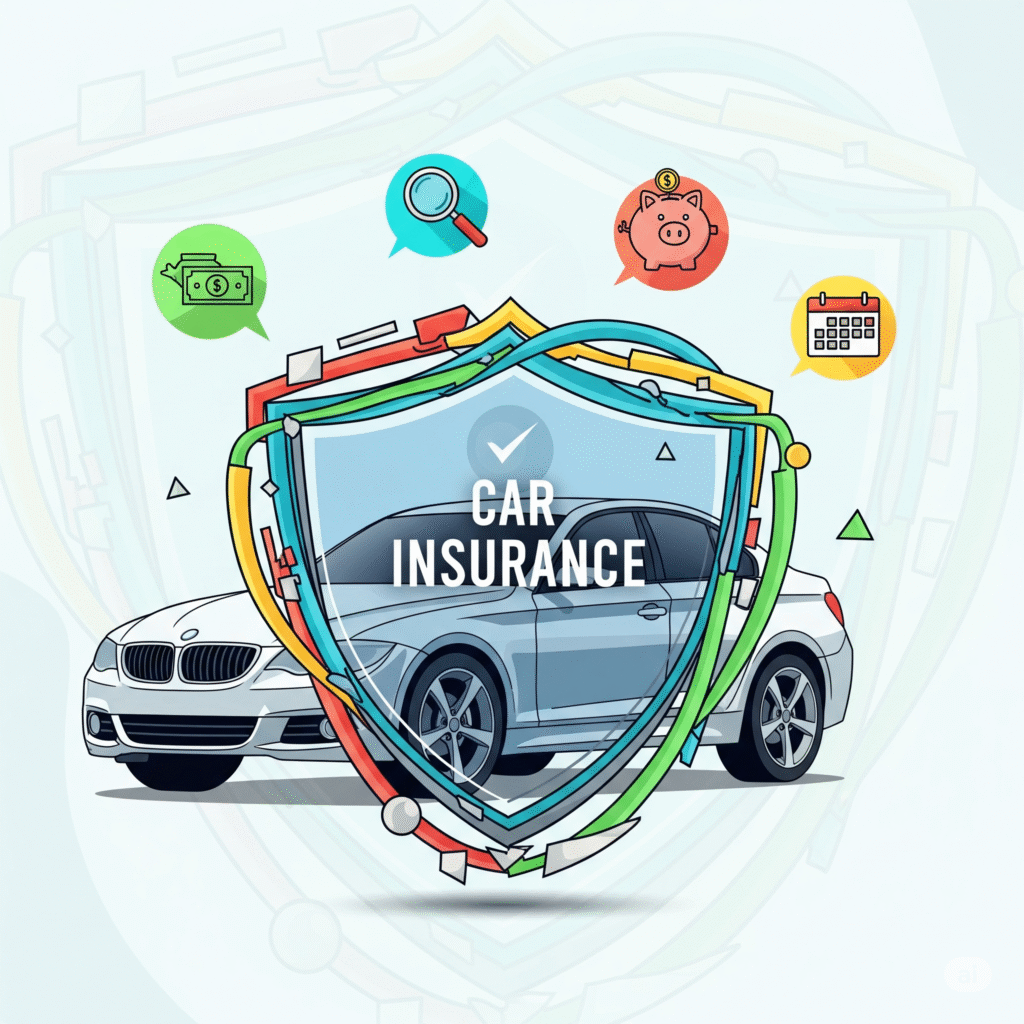
Some coverage and optional add-ins offered by car insurance
Own Damage Coverage:
- Protects against damage to your own vehicle from accidents, collisions, theft, fire, vandalism, and natural disasters (such as storms, floods, earthquakes).
- Covers a wide range of risks, including damage to car parts like bumpers, doors, windshield, engine (in case of accidents), and electrical components.
- Some parts or situations may require additional add-ons for full coverage.
- Usually included in a comprehensive insurance policy.
Third-Party Liability:
- Mandatory insurance component as per Indian law.
- Covers damages or injuries you cause to others (third parties), including their property damage and bodily injuries.
- Does not cover damage to your own vehicle.
- Protects you financially against claims from others.
Theft and Disasters:
- Theft and damage from natural disasters (fire, floods, storms, earthquakes) are covered under the comprehensive part of the policy.
- This coverage is distinct from collision coverage, which applies to accident-related damage.
- Provides financial protection against loss or damage due to such unforeseen events.
- Comprehensive car insurance also covers damages caused by attempted theft, including broken windows, damaged locks, or forced entry marks. This means even if the vehicle is not successfully stolen, the financial loss from the damage done during the theft attempt is compensated by the insurer.
Collision Coverage
- Pays for repair or replacement of your car after a collision, regardless of fault.
- Covers accidents with other vehicles, stationary objects, or rollovers.
Requires you to pay a deductible; insurer pays the rest up to the policy limit. - Does not cover theft, vandalism, or natural disasters (these are covered by comprehensive insurance).
- In India, collision coverage is not available as a standalone policy; it is included as part of comprehensive insurance.
- Not legally mandatory, but often required for financed or leased cars.
Protects your own vehicle, unlike third-party insurance which covers others’ damages.
Zero Depreciation:
- An add-on to standard car insurance.
- Ensures you receive the full claim amount for replaced car parts without any deduction for depreciation.
- Particularly beneficial for new or expensive vehicles, as it covers the entire cost of parts replaced after an accident.
Engine Protection:
- An optional add-on cover in car insurance.
- Pays for repair or replacement costs of your car’s engine and its components due to water ingression, oil leakage, or accidental damage.
- Not included in standard policies; must be purchased separately, especially useful in flood-prone areas.
Personal Accident Cover:
- Mandatory Add-on: Required by law for all vehicle owners in India.
- Coverage: Provides financial compensation for accidental death, permanent or partial disability, and injuries to the owner-driver due to a road accident.
- Sum Insured: Standard coverage is ₹15 lakh (as per IRDAI guidelines).
- Medical Assistance: Covers medical expenses and hospitalization due to accident-related injuries.
- Disability Benefit: Offers a lump sum payout in case of permanent or partial disability.
- Nominee Support: Compensation is paid to the nominee or family in case of the policyholder’s death.
- Eligibility: Valid only if the owner-driver holds a valid driving license at the time of the accident.
- Exclusions: Does not cover incidents like suicide, intoxication, or hazardous activities.
Eligibility:
- Minimum Age: The applicant must be at least 18 years old.
- Citizenship: The applicant must be a citizen of India.
- Vehicle Ownership: The applicant must own a vehicle and possess its valid Registration Certificate (RC).
- Driving License: The applicant must have a valid driving license.
- Required Documents: Proof of identity, address, and vehicle registration are necessary to purchase a policy.
Vehicle specific eligibility
- Registration: The vehicle must be registered with the relevant Regional Transport Office (RTO) and possess a valid Registration Certificate (RC).
- Vehicle Type: Insurance is available for all types of vehicles—private cars, commercial vehicles, two-wheelers, goods carriers, passenger vehicles, etc. The type of insurance policy and premium may vary based on the vehicle category (e.g., private car, commercial vehicle, heavy goods vehicle, etc.).
Read More
- Insured’s Declared Value (IDV): The sum insured is based on the vehicle’s age, make, model, and current market value. For vehicles up to 5 years old, IDV is calculated using depreciation on the showroom price; for older vehicles, it’s based on the prevailing market value agreed upon by the insurer and insured.
- Modifications and Accessories: Any modifications (like CNG/LPG kits or additional electronic fittings) must be declared and may require additional premium.
- Ownership: The policyholder must be the legal owner of the vehicle. In case of transfer of ownership, the insurance policy must also be transferred within 14 days.
- Compliance with Law: The vehicle must comply with all legal requirements, including having valid permits (for commercial vehicles), pollution under control (PUC) certificate, and not being used for illegal purposes.
- Mandatory Third-Party Insurance: Every vehicle plying on public roads must have at least third-party liability insurance, which is a legal requirement.
- Personal Accident Cover: For private cars, personal accident cover for the owner-driver is mandatory.
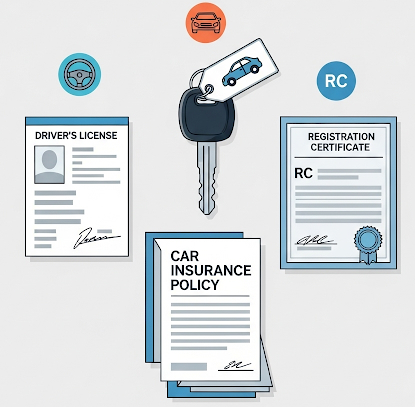
Required documents for vehicle-specific car insurance:
Registration Certificate (RC) of the vehicle
Proof of identity and address of the owner
Valid driving license
Previous insurance policy (if renewing)
Details of modifications/accessories, if any
Features Of Car Insurance:
- Comprehensive Coverage: Protects against damage to your vehicle due to accidents, natural disasters (floods, earthquakes, cyclones), fire, theft, riots, terrorism, and transit damage. It offers financial assistance for repair or replacement of your own vehicle.
- Third-Party Liability: Mandatory by law in India, this covers injury or death of third parties and damage to their property caused by your vehicle. It does not cover your own vehicle’s damages.
Read More
- Personal Accident Cover: Provides compensation in case of accidental death or permanent disability of the owner/driver, and sometimes passengers.
- No Claim Bonus (NCB): A discount on premium for policyholders who do not claim during the previous policy period, encouraging safe driving.
- Add-on Covers: Options to enhance coverage, such as zero depreciation, engine protection, roadside assistance, and more.
- Cashless Garages: Access to a network of approved garages where repairs can be done without upfront payment, simplifying claims.
- Legal Protection: Safeguards against legal liabilities arising from accidents involving the insured vehicle.
- Coverage for Own Damage: Includes collision insurance covering damages to your vehicle caused by accidents or collisions with objects or other vehicles.
- Protection Against Theft and Fire: Covers losses due to vehicle theft or fire damage.
- Coverage for Natural and Man-made Calamities: Includes damages from floods, earthquakes, riots, vandalism, terrorism, etc.
Terms and Conditions of Car Insurance
Coverage Types:
- Third-Party Liability Insurance: Mandatory by law; covers legal liabilities arising from injury, death, or property damage to third parties caused by your vehicle.
- Comprehensive Insurance: Optional; covers third-party liabilities as well as damage to your own vehicle due to accidents, theft, fire, natural or man-made calamities.
- Personal Accident Cover: Provides compensation for death or disability of the owner-driver or paid driver as per the policy terms (e.g., up to ₹15 lakh for owner-driver)
Read More
- Compensation Limits:
- For third-party property damage, compensation can be up to ₹7.5 lakh.
- For passengers, IRDAI recommends a cover of ₹25,000 per person.
- Deductibles: A standard deductible is applicable on every claim—₹1,000 for cars up to 1500cc, ₹2,000 for cars above 1500cc.
- Depreciation: The claim amount for parts is reduced based on the car’s age and part type. For example, cars over 5 years old but under 10 years have a 40% depreciation rate applied to most parts.
- Exclusions: The insurer is not liable for:
- Consequential loss, normal wear and tear, mechanical/electrical breakdown.
- Damage when the driver is under the influence of alcohol/drugs.
- Intentional damage, self-injury, or suicide attempts.
- Damage to tyres and tubes unless the vehicle is also damaged, and then only up to 50% of replacement cost.
- No Claim Bonus (NCB): A discount on premium for claim-free years, but it lapses if the policy is not renewed within 90 days of expiry.
- Policy Validity & Renewal: Policies are usually valid for one year. Timely renewal is essential to maintain coverage and NCB. If not renewed within 90 days, NCB is lost.
- Geographical Limit: Standard policies are valid only within India.
- Policy Cancellation: Allowed only in cases such as double insurance, total loss, or sale/transfer of the vehicle.
- Total Loss: If repair costs exceed 75% of the Insured Declared Value (IDV), the car is considered a total loss and the RC (Registration Certificate) must be surrendered.
- Legal Compliance: Offering or accepting unauthorized rebates on premium is prohibited and punishable by law.
Scenarios where claim might get rejected
- Fraudulent or Invalid Claims: If the claim is found to be exaggerated, false, or not genuine, it will be rejected.
- Undeclared Modifications: If you have made modifications or added accessories to your car without informing the insurer, claims related to those parts or resulting incidents can be denied.
- Violation of Policy Conditions: Using the car for a purpose not declared (e.g., using a privately insured car for commercial purposes) can result in claim rejection.
Read More
- Delay in Reporting: Not informing the insurer about the accident or loss within the stipulated time frame (usually 48–72 hours) can lead to rejection.
- Lapsed Policy: If your insurance policy has expired or you have missed premium payments, any claim made during this period will be rejected.
- Unapproved Repairs: Getting the car repaired before the insurer’s inspection or without their approval can invalidate your claim.
- Lack of Required Documentation: Failure to submit necessary documents (policy papers, RC, FIR, driving license, etc.) can result in claim denial.
- Claims Outside Coverage Scope:
- Damages from normal wear and tear, mechanical or electrical breakdown, or depreciation (unless covered by add-ons like zero depreciation) are not covered.
- Claims for incidents occurring outside the geographical area covered by your policy (e.g., outside India) will be rejected.
- Policy Exclusions: Claims arising from excluded situations, such as suicide, intentional damage, or participating in illegal activities, will not be entertained.
- Driver-related issues
- i. Driving without a valid license: If the driver does not have a valid or appropriate driving license at the time of the accident, the insurer will reject the claim.
ii. Driving under the influence: Claims will be denied if the driver was under the influence of alcohol or drugs during the incident.
iii. Violation of traffic rules: Engaging in reckless driving, over speeding, or breaking traffic laws can result in claim rejection.
iv. Using the vehicle for unauthorized purposes: If a private vehicle is used for commercial activities without proper coverage, claims can be denied.
v. Negligent or unlawful driving: Actions such as participating in illegal races or rallies, or intentionally causing damage, are grounds for rejection.
How to avoid such Claim rejections:
- Always drive with a valid and appropriate driving license.
- Never drive under the influence of alcohol or drugs.
- Follow all traffic rules and avoid reckless driving.
- Use the vehicle only for the purpose declared in your policy (private or commercial).
- Do not participate in illegal activities like street racing or rallies.
- Keep your insurance policy and documents updated.
- Inform your insurer about any vehicle modifications or changes.Ensure all potential drivers of your vehicle are aware of and follow these guidelines.
- Provide honest and accurate information when filing claims.
- Inform your insurer about any car modifications or added accessories.
- Use your vehicle only for the declared purpose (private or commercial).
- Ensure the driver has a valid license and is not under the influence.
- Report accidents or losses to your insurer promptly (within 24–48 hours).
- Keep your insurance policy active by paying premiums on time.
- Get insurer approval before repairing your car after an incident.
- Submit all required documents accurately and promptly.
- Understand your policy’s coverage and exclusions; don’t claim for items not covered.
